
Liquidation Pallets For Sale
The Professional Reseller’s Guide to Power Tool Liquidation Pallets: Unit Economics, Battery Diagnostics & Resale Strategy
Oct
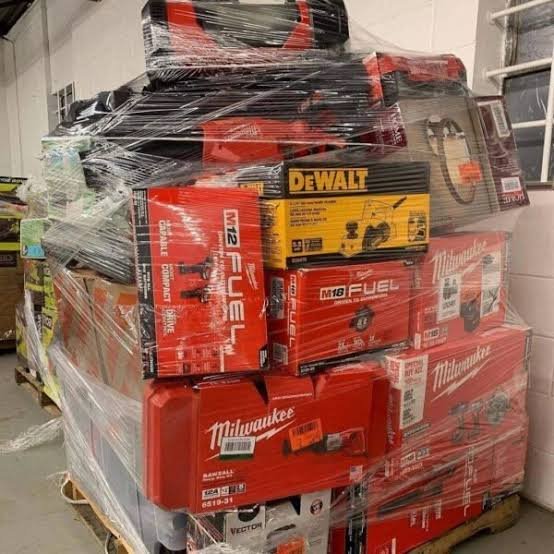
Power tool liquidation is widely considered the gold standard of retail arbitrage. Unlike seasonal fashion or delicate glassware, contractor-grade power tools from top brands—such as Milwaukee, DeWalt, Makita, Ryobi, Bosch, and Ridgid—command immediate brand recognition, maintain exceptional value retention on secondary markets, and possess an active aftermarket for bare tools, batteries, and replacement parts.
However, purchasing power tool liquidation pallets for sale comes with distinct operational demands. High-end cordless equipment contains brushless DC motors, digital microcontrollers, and lithium-ion battery packs that require systematic bench testing. Flippers who know how to diagnose simple electrical faults, jump dormant battery packs, and source inexpensive bare-tool housings can consistently generate 70% to 120% net margins.
This guide provides a comprehensive operational blueprint: from analyzing realistic manifest economics and battery revival protocols to navigating tool serial tracking and multi-channel liquidation strategies.
1. Unit Economics: Manifest Financial Breakdown
Power tool lots sourced from major home improvement retailers (such as Home Depot or Lowe’s) typically arrive as Customer Returns, Shelf Pulls (Display Models), or Damaged-Box Overstock.
Below is a unit-level financial analysis based on a standard 16-piece manifested power tool pallet sourced through Liquid Pallets Hub:
Financial Breakdown Table (16-Unit Manifested Lot)
| Item Classification | Qty | Retail MSRP | Condition / Grade | Refurb / Parts Cost | Target Resale Price | Gross Resale Value |
|---|---|---|---|---|---|---|
| 18V Brushless 1/2″ Impact Wrench (Bare) | 2 | $249.00 | Grade A (Shelf Pull / Mint) | $0.00 | $165.00 | $330.00 |
| 20V Hammer Drill & Driver Combo Kit | 2 | $299.00 | Grade A (Open Box / Complete) | $0.00 | $195.00 | $390.00 |
| 7-1/4″ Cordless Circular Saw (Bare) | 2 | $199.00 | Grade B (Scuffed base / Works) | $12.00 (New blade) | $125.00 | $250.00 |
| 18V Cordless Reciprocating Saw (Sawzall) | 2 | $169.00 | Grade B (Tested functional) | $0.00 | $105.00 | $210.00 |
| Dual-Port Fast Charger + 2x 5.0Ah Batteries | 3 | $229.00 | Grade B (Cells re-balanced) | $0.00 (Bench cycle) | $135.00 | $405.00 |
| 12V Compact Drill/Driver (Bare) | 3 | $99.00 | Grade A/B (Minor cosmetic use) | $0.00 | $60.00 | $180.00 |
| Damaged / Burnt Armature (Parts Only) | 2 | $179.00 | Grade D (Stripped chuck/housing) | $0.00 | $45.00 (eBay parts) | $90.00 |
| TOTALS | 16 | $3,294.00 | 87.5% Working Yield | $24.00 Supplies | — | $1,855.00 Gross |
Net Profit & Margin Summary:
[ Investment Ledger ]
  ├── Pallet Purchase Price (at ~20% of MSRP):       $660.00
  ├── Inbound LTL Freight Allocation:                 $165.00
  ├── Reconditioning Supplies (Blades, Contacts):     $24.00
  ├── Blended Sales Channel Fees (10.5% Avg.):        $194.78
  └── Total Invested Capital:                         $1,043.78

[ Net Return Summary ]
  ├── Total Gross Sales Realized:                     $1,855.00
  ├── Total Cost of Goods Sold & Expenses:            -$1,043.78
  └── NET PROFIT:                                     $811.22 (77.7% Net ROI)
Ready to scale your hardware and contractor supply inventory? Explore our manifested lots of power tool liquidation pallets to inspect tool manifests, brand distributions, and live lot pricing.
2. Understanding Tool Brands: Sourcing Tiers & Resale Velocity
When reviewing tool manifests, categorize inventory into three distinct performance and margin tiers:
[ Power Tool Sourcing Tiers ]
  ├── Tier 1: Professional / Contractor Grade (Milwaukee FUEL, DeWalt XR, Makita LXT)
  │    └── Highest demand, commands 65-75% of MSRP used, instant local contractor sell-through.
  ├── Tier 2: Prosumer / High-Tier DIY (Ridgid 18V, Ryobi ONE+ HP, Craftsman V20)
  │    └── Fast turnover on local marketplaces, excellent for starter kits and home flippers.
  └── Tier 3: Budget / DIY Consumer (Black+Decker, Hyper Tough, Genesis)
       └── Lower individual margin; best sold in bundled multi-tool lots at flea markets.
Brushless vs. Brushed Motors: Always check the manifest for “Brushless” designations (e.g., DeWalt XR, Milwaukee M18 FUEL). According to hardware testing data from Pro Tool Reviews, brushless motors yield up to 50% longer runtime and generate zero internal brush friction. Resellers can price brushless bare tools 20% to 35% higher than older brushed variants.
3. The 5-Step Bench Testing & Refurbishing Protocol
Testing power tools systematically separates high-margin “Tested / Functional” listings from risky “For Parts” inventory.
Visual Intake ──> Multimeter Cell Test ──> Low-Voltage Wake-Up ──> Motor Load Bench ──> Clean & Grade +--------------------------------------------------+
| STEP 1: VISUAL INTAKE |
| Check chuck alignment, gear collar, battery clips|
+-------------------------+------------------------+
|
v
+--------------------------------------------------+
| STEP 2: BATTERY PACK AUDIT |
| Measure terminal voltage with digital multimeter |
+-------------------------+------------------------+
|
v
+--------------------------------------------------+
| STEP 3: 0V WAKE-UP / CELL REVIVAL |
| Balance asleep BMS circuits using bench supply |
+-------------------------+------------------------+
|
v
+--------------------------------------------------+
| STEP 4: DYNAMIC RUN TEST |
| Test 1 & 2 speed gears, variable trigger & brake |
+-------------------------+------------------------+
|
v
+--------------------------------------------------+
| STEP 5: GRADE, PHOTO & LIST |
| Grade A (Like New) | Grade B (Used) | Parts Unit |
+--------------------------------------------------+
Step 1: Physical Housing & Chuck Inspection
- Check the chuck on drill/drivers for axial play (wobble or “runout”). Run a straight 6-inch drill bit inside the chuck at full speed; if the tip vibrates off-center, the internal spindle is bent.
- Inspect gear selector switches (Hammer, Drill, Drive) to ensure the internal planetary gearbox shifts smoothly between high-torque and high-speed settings.
Step 2: The Battery Pack Diagnostics (Voltage Check)
Customer return pallets frequently include battery packs marked “Dead / Defective.” In reality, modern lithium-ion packs enter a protective sleep state when their Battery Management System (BMS) registers voltage below a critical threshold (typically <2.5V per cell):
- Set your multimeter to DC Voltage (20V scale).
- Measure between the positive (
+) and negative (-) terminals. - A healthy, charged 18V/20V Max pack should read between 18.0V and 20.5V. If the multimeter reads 0.0V to 8.0V, the internal cells are locked out by the BMS sleep circuit, not physically damaged.
